Doll's House | Collingwood - Victoria's smallest house |
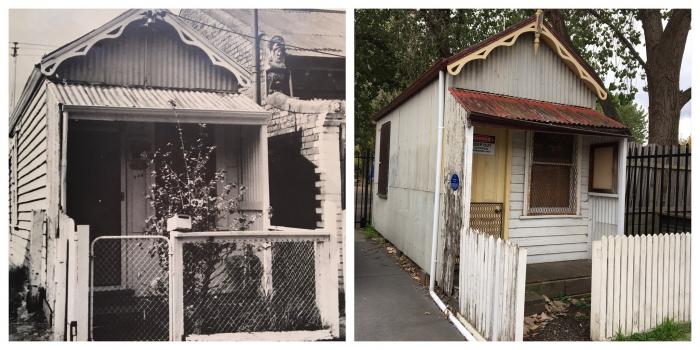
This two roomed, 2.5 metre wide cottage was built at 130 Islington Street following a subdivision in the mid 1870s.
Believed to be one of the smallest houses in Victoria, it is known locally as the Doll's House because of its size.
Rate books show that it was one of the smallest in the street and attracted the lowest rates, only a fraction more than those blocks that were land only.
Despite its size this tiny dwelling was a home for several families for over a century.
It was first owned by Mrs Mary Barker (occupation, home duties), for ten years or so. James Peddie, a blacksmith, bought the house in about 1886 and lived there with his wife and young daughter, Lilly May. Lilly died at the age of six only a couple of years after moving into the house but the couple continued to live there until the early 20th century when they moved to Wellington Street. They let the house to a succession of tenants: Margaret Catlin, home duties; Sydney Andrewartha, a woodturner with two children; George Hirst, a labourer; Mrs Ellen Williams and then her daughter Mary Williams. There were usually three or four people living in this tiny house together. James Peddie eventually sold the house in the late 1920s to Mrs Emma Podger, who lived there with two other people for about fifteen years. The Jacksons, mother and son, then owned the house and lived there for nearly thirty years before the Education Department bought the property in 1978.
The Dolls House PlaqueThis part of Collingwood is largely industrial now; it was formerly a working class residential area. The residents were a mix of owner/occupiers and tenants, and were labourers, blacksmiths, wood choppers, factory workers and the like, just as the Doll's House's residents were.
Much of Collingwood, including this area, was commonly known as the Collingwood Flat, a topographical reference. The area became known as a 'slum' area and the Doll's House rated a reference and photo in the Housing Investigation and Slum Abolition Board Report 1937. However, the house survived and was lived in for another forty years.
The house originally had a fireplace in the internal wall. The fireplace was removed sometime before the 1940s, probably to make space.
In the mid 1970s the houses in the streets surrounding the Doll's House were demolished as Hoddle Street was widened and land cleared for the new Collingwood Education Centre. Because of its special interest the Doll's House was not demolished by the Education Department and was left standing alone in Islington Street while Collingwood Council decided what to do with it. In 1978 it was rescued by local businessman Bob Neylon who moved it into his building equipment hire yard at 103 Wellington Street. He restored and furnished it and opened it to the public as 'the smallest house in Australia'. When he died in 1984 the Council again wondered what to do with the cottage. Eventually it was dismantled and stored for some years at the Collingwood Council Depot in Walker Street Clifton Hill while a decision was made as to its future. It was eventually reconstructed in the Depot in 1991 and by 1995 was back in Collingwood at the corner of Cromwell Street and McCutcheon Way in the care of Collingwood College, not far from its original home.
It was cited by the National Trust in 1985 (File no. B2511) and was later registered by the Historic Buildings Council (VHR HO954), significant as the smallest extant house in Victoria.
References
Collingwood History Collection, 'Doll's House File'.
http://vhd.heritagecouncil.vic.gov.au/places/1584
Rate Books, Collingwood, various years.
Sands & McDougall, Melbourne Directories, various years.
Collingwood's 'Doll House': The history of Victoria's smallest house
By Emily Power | domain.com.au
June 3, 2026
Built in the 1880's and still standing, the smallest house in Victoria is a powerful reminder of how people once lived in seemingly impossible conditions.
At 2.59 metres wide, the Doll's House in Collingwood is a relic of subdivisions in Melbourne's inner-city slums in the 1870s. Three to four residents at a time were squeezed into its two rooms up until 1978.
The Doll's House is registered with Heritage Victoria and is believed to be the state's smallest surviving house. It looks sweet, with a petite porch and scalloped roofline, but life for the low-income workers who lived side-by-side in these homes more than 150 years ago was far from a fairy tale.
The cottage originated at 130 Islington Street but moved to its current address, in the grounds of Collingwood College, in 1995. It was surrounded by similar, but larger, houses, which were demolished in the mid-1970s. They were removed to widen the major arterial of Hoddle Street and expand the suburb's infrastructure.
The house's astonishing size is related to the high cost of land, even in the 19th century. That much has not changed, although Collingwood's proudly working-class background now has a cosmopolitan tinge. The median house price in the suburb is $1.255 milion, according to Domain.
The property was privately owned, preceding social housing.
"The reason why this house and others like it was so small was because the cost of land, even in the 1870s and 1880s, was quite expensive and therefore landlords could only usually afford small parcels of land and small houses," explains Dr Benno Engels, an RMIT University senior lecturer in urban and regional planning. "It's all to do with economics. The price of house and land in the inner-city gentrified areas now is very expensive, and it was then."
The cottage was mentioned in a 1937 report by a government-appointed body set up to investigate the congested slums in suburbs such as Collingwood, Fitzroy and Richmond. Homes were tumbling down and lacked sanitation, and residents endured extreme poverty. They were "hotbeds of depravity and disease", said the report, which is in archives at the State Library of Victoria.
"The people who could afford to escape the smell and the over-crowding jumped across the Yarra River or moved out to North Fitzroy, North Carlton or to Essendon," Dr Engels says.
In 1938, a new state Housing Commission began the long process of dismantling the slums and building social housing.
Dr Engels says rent controls that followed contributed to the deterioration of private rentals. "Landlords weren't going to put more money into housing that they couldn't generate more income from," he says. "We did not have a welfare state really until the end of World War II, and then it was a very mean welfare state."
Collingwood Historical Society vice president Janet Taylor says the Doll's House was typical of the only accommodation available. "There were times when Collingwood had a much higher population than it has now, but didn't have any high-rise buildings to put people in," she says. "There were rows of these little houses, some timber, some brick, but there were large numbers of people and families sleeping in them. The baths would have been a tub in the backyard or in a lean-to kitchen, with water heated on the stove."
The inside of the Doll's House is basic, Taylor says. It doesn't have fixtures such as a stove, but has sometimes been dressed with a bed, a table and chairs.
The first owner in the 1880s was a woman named Mary Barker, according to the Collingwood Historical Society. The second owner, James Peddie, bought it in 1886 and leased it to several tenants through the decades. Peddie sold the cottage in 1920, and it changed hands three more times. Residents included blacksmiths, woodturners and labourers.
The Education Department bought the building in 1978 from a mother and her son, who had lived there for 30 years. A local businessman, Bob Neylon, who Taylor described as a "collector", stepped in. He restored the house and kept it as his premises, promoting it to tourists as Australia's smallest house (a claim of dubious accuracy).
After he died in 1984, the house was taken apart and sent to a council depot, pending a decision. It was pieced together in 1991, and four years later, it was moved to the school.
The Collingwood Historical Society has long been a watchful advocate of the Doll's House, especially when it was in storage. "We wanted to make sure it was preserved and put in a more appropriate place," Taylor says. "We have always maintained an interest in its preservation."
It has a Heritage Council of Victoria plaque, Taylor says, so "people know it is more than a little wooden shed".
A Heritage Victoria spokesperson says the Doll's House is in the care of the Victorian School Building Authority and Collingwood College. The school was given a grant by the council to further restore it in 2014.
It is unclear how the cottage survived while others like it were knocked down, but Taylor and Dr Engels say it is probably because it was a curiosity. What's certain is that it's much more than a design quirk. It's a rare physical record of how the most vulnerable Melburnians lived.
The Doll's House has survived generations of development and dismantling, and the historical society wants it to endure. Given the number of restorations, Taylor says it's not known how much of the structure is original. "I hope that they can manage to maintain the fabric of it, because it could just rot away if it doesn't have some care," she says.
A photo of the Doll's House in Collingwood, taken in the 1980s. During this period it was restored by a local businessman, who promoted it as Australia's smallest home. Photo: City of Yarra Libraries
❊ Key Information ❊
Where
130 Islington Street Collingwood Victoria
Official Links
Maps
[ Google Map ] [ Hotel Finder ]
Page ID#
668604 - To request changes, locate the Update button on our Contact Page and follow the prompts. Please quote this Page ID.
→ Disclaimer: Information can change at any time. Check with the advertiser with the links included before making plans, buying tickets or proceeding...
❊ Also See.. ❊
➼ Collingwood College
❊ Trending HOT ❊

On Thursday 22 October 2026, Tixel is setting up a giant wall of tickets worth $40K+ outside State Library Victoria. Win $40K in tickets Melburnians are being..

Make the most of your weekend in Melbourne with these fabulous events. No city does it better than Melbourne, so get out and discover the very best shows, festivals,..