Melbourne's Golden Mile Heritage Trail |
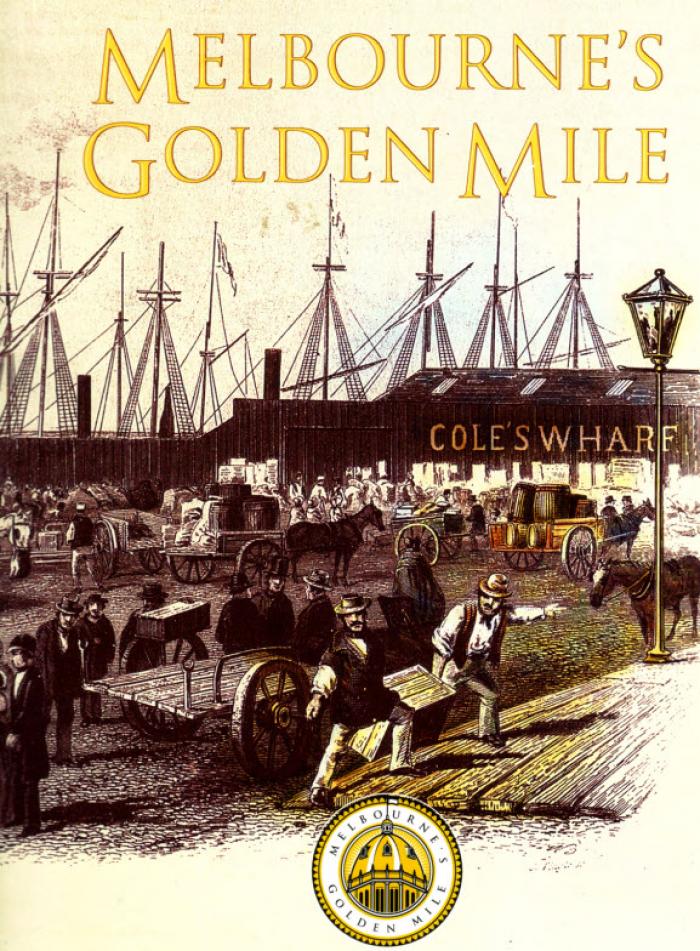
The walk complements Melbourne's Golden Mile trail that covers, in ten precincts, the story of Melbourne from 1835 to 1901.
Melbourne's Golden Mile is a self-guided heritage trail that follows brass discs embedded in Melbourne's pavements.
Taking tourists past the most significant buildings, the trail traces the development of Melbourne from a small and isolated settlement to one of the world's most significant cities and focuses on the wealth created by gold.
Melbourne's Golden Mile starts at the Immigration Museum in Flinders Street and ends at the Royal Exhibition Building and the new Melbourne Museum.
Golden Mile Walks
Melbourne's Golden Mile is four independent walks.
Each has a distinctive theme but there are overlaps in the themes and approaches across the four walks.
Each walk is enquiry based and includes aspects of historical methodology, recording, observation of the environment and use of evidence to form conclusions.
Each walk takes approximately ninety minutes to complete.
Download Heritage Trail (PDF)
egold.net.au
This website is a living resource for those interested in family or local history, technology or material culture, and is tailored to the needs of students, scholars, enthusiasts, visitors and the general public.
egold.net.au was produced by the Cultural Heritage Unit in the School of Historical Studies at the University of Melbourne, which is undertaking Australian Research Council research projects on the Australian goldfields and on rural and regional history. The Unit supervises many PhD research projects in these study areas, and has considerable experience in developing digital and on-line resources.
The Golden Metropolis: Overview
Gold was the cause of the great expansion of Melbourne from 1850. The major gold fields were inland, though some gold was discovered in 1850 at Anderson's Creek, near Warrandyte. The Melbourne that greeted the tide of gold immigrants had 23,000 residents and was thus far more established than for example San Francisco at the time of the discovery of gold in California, which had only about a thousand residents. Nevertheless, the rapid influx of people was more than any small city could adequately house or care for in the short term - historian Geoffrey Serle referred to the earlier 1850s as the 'crisis years'. In just four months in 1852, 619 ships arrived in Hobson's Bay, carrying 55,057 passengers; 1853 saw the arrival of 2,594 ships. At Sandridge (Port Melbourne) many, learning the high price of transport and storage, tried to sell excess possessions, or simply abandoned them on the beach. Most of the incoming gold seekers would leave Melbourne within a few days for the diggings, complaining of the roughness of the town and the astonishing prices of all the necessities of life.
❊ Web Links ❊
➼ www.egold.net.au
❊ Also See.. ❊
➼ The University of Melbourne
Trending HOT

Australia's first regular-season NFL game has made the MCG one of Melbourne's hottest tickets, with tickets sold out. If you missed a seat for the Los Angeles Rams v..

Make the most of your weekend in Melbourne with these fabulous events. No city does it better than Melbourne, so get out and discover the very best shows, festivals,..
Update Page
Tags: culture,history,museum,sport,auto,expo,immersive,kids,science,travel