Boolarra 3870 |
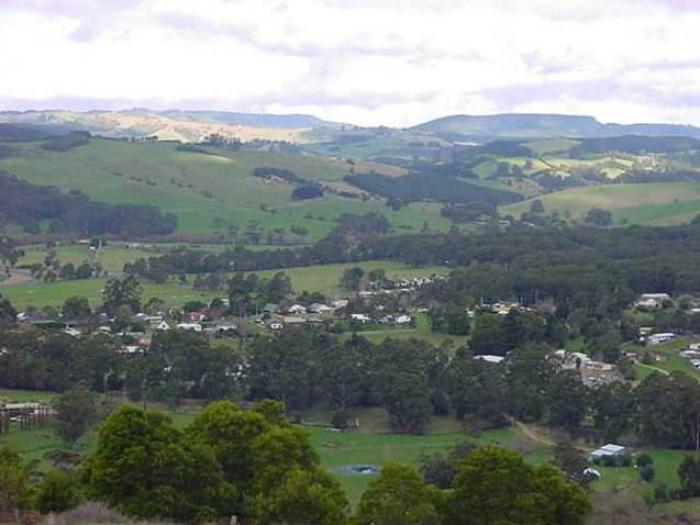
Boolarra lies in the foothills of the Strzelecki Ranges, twenty kilometres south of Morwell in the Latrobe Valley.
The area was first visited by Europeans in 1840 when the explorer Strzelecki passed nearby. The terrain was so rough, the party abandoned their horses and equipment and continued on foot, reaching Westernport Bay three weeks later.
Settlers did not penetrate the forests in this area until the late 1870s. When the railway line from Morwell to Mirboo North was constructed in the early 1880s, a camp and station were established at the twelve mile peg from Morwell. A township was surveyed in 1884 and named Boolarra, an Aboriginal word meaning plenty.
Some black and brown coal was mined in the area although never on a large scale. The discovery of larger deposits elsewhere caused production to cease. Timbercutting became the most important industry. Several sawmills operated in the area and paling splitting was also an important occupation. The palings and blackwood logs were transported by rail.
Clearing the forest for farming progressed slowly at first. Red Wednesday, the bushfire of 1898, while ruining some selectors, aided others by burning the scrub and leaving an ash bed for rapid growth of grass. The establishment of a creamery, allowing more efficient separation of milk, assisted the growth of a dairying industry. In 1900 a butter factory was set up in Boolarra by Heymans.
In the early days, tracks were rough and winding, muddy in winter. Gradual improvements in roads reduced the isolation of the settlers and the isolation of Boolarra itself.
There were three hotels, three general stores, bakers, butchers and other stores, blacksmiths, bootmakers, a tinsmith and a coachbuilder. Swimming baths were constructed in 1914 and a recreation reserve, Memorial Park, was opened in 1924. There was a strong community life with sports meetings, woodchops, horse races, dances and a newspaper. Boolarra was a service centre for a wide district, supporting the dairy and timber industries. The monthly cattle sale especially brought people into town.
Boolarra suffered a setback in 1937 when a hotel and many shops in the main street burned down. Population declined until the 1970s, as in most country towns. Improvements in farming technology required fewer workers and there was a general drift of population to the cities.
However from the 1970s, people have been attracted back to the area by the rural lifestyle. There has been substantial residential building and subdivision of small farmlets and small properties in the hills overlooking the town. In 1986, the population was 589 and by 1991 was 607. This has produced little increase in business and services because with modern cars and better roads people use the larger provincial centre. But there has been an increase in local community activities such as service clubs and sporting and social organisations. For example, the community organised the removal of a building from Yallourn to house an infant welfare service, playgroup and other community groups. A community newspaper was started in 1982.
Dairying is still an important industry, although the butter factory closed in the late 1950s. Milk was taken to Yinnar until that factory was taken over by a large company in 1974. The last cattle sale was held in 1982. A fish farm was started in the 1950s. It now has thirty to forty acres of ponds and breeds five different species of goldfish, sending them all over Australia.
Boolarra's census populations have been 220 (1891), 370 (1933) and 503 (1961).
Boolarra, Victoria
Boolarra is a small township located in the Latrobe Valley, in central Gippsland, Victoria, Australia. At the 2016 Census, Boolarra had a population of 973 with 48% males and 52% females and an average age of 50. The Boolarra Folk Festival is held in the town every year in March and attracts music lovers from around Australia and the world. The town is also infamous for producing the Boolarra strain of carp (Cyprinus carpio) which, after their release into the Murray River near Mildura, spread throughout Australia.
The name Boolarra is believed to be derived from an expression in one of the local Aboriginal languages meaning 'plentiful' or 'twenty'. The Post Office opened on 1 September 1884 prior to the railway arriving in 1885.
The town is at one end of the Grand Ridge Rail Trail, which travels for 13 kilometres through temperate rainforest and dry sclerophyll forest in the Strzelecki Ranges. The original railway branch line from Morwell to Boolarra, was opened on 10 April 1885, with the last train being run on 22 June 1974. The railway was constructed through difficult hilly terrain requiring construction of massive embankments and numerous bridges.
The town has an Australian Rules football team competing in the Mid Gippsland Football League.
History
Prior to colonisation, the Boolarra area was part of the country of the Gunaikurnai people, who had lived there for over 20,000 years.
The first European settler, W.H. Penaluna, arrived around 1878, taking up land along the Morwell River and erecting the Settlers' Arms Hotel. Land was quickly taken up, when a railway line was built in 18845, connecting Mirboo North, Boolarra and Yinnar to Morwell, on the main MelbourneSale line.
The hill country south and east of the Morwell River was opened up and a series of small communities, such as Budgeree, Gunyah, Ruyton Junction and English's Corner, began to flourish as goods and services flowed to and from Boolarra, which was the commercial and agricultural centre of the district.
Initially, the early settlers depended on timber and mixed farming for their livelihood. Blackwood for furniture and palings, cut from the surrounding forests, was freighted to Melbourne.
Butter, salted and packed on the farm, was also sent to the city. In 1905, the Danish firm Heyman set up a butter factory in Boolarra, and dairying became the main industry of the district. At that time, Boolarra's population rivalled that of Morwell.
At its peak, Boolarra supported three general stores, three hotels and four churches, along with two butchers, two bakers and three confectionery shops. Horses were harnessed and shod by two blacksmiths and the butter factory provided the bulk of employment for the town's youth. At one stage, a black coal and bauxite mine triggered an investment flow into the town.
In 1937, a large fire raged through Tarwin Street, destroying many of the original shop fronts.
After World War II, residents banded together to create a Memorial Park, with the names of the town's fallen soldiers inscribed on its gates.
Today
Modernisation of farming and improved transport links have brought changes to many small rural towns, with car travel to the larger commercial centres in the Latrobe Valley increasing.
Boolarra, no longer a centre, has settled down to become an attractive town with a friendly rural atmosphere.
Today a large fish farm exports goldfish to the national market.
Despite being related to carp, little is known about the impact goldfish have on native fish, particularly in regard to competition for food, resources and habitat. Few detrimental effects have been recorded, however, this may be due to limited research. One impact that has been well recorded is the transmission of disease.
Goldfish ulcer disease (GUD) is a bacterial disease first isolated from a goldfish farm in Victoria in 1974. Since then outbreaks have occurred at warm water fish hatcheries in NSW and Victoria. NSW DPI researchers have found that fingerlings of Murray cod, golden perch and silver perch are resistant to GUD. However, there has been one recorded outbreak of the disease in a silver perch fish farm in NSW. Trout are at high risk of infection.
Farming is still important, as is Timber, which is harvested from plantation forests in the hills. There has been an influx of new residents, retirees and young families from the city. The old railway line, closed in 1974, has become an attractive Rail Trail bush walk from Boolarra to Mirboo North. The Old Boolarra Pub has been restored.
Numerous sporting clubs use the recreational facilities of the Memorial Park, a modern school and kindergarten provide educational facilities, and an historical society has converted the Old Boolarra School into a museum to preserve the local heritage.
Shops and cafes in Boolarra include the Boolarra Community Hotel, Boolarra Store (general store/cafe), post office, and the Boolarra Emporium.
In 2011, The Boolarra Australian Rules Football team, known as the Demons, won their first Mid-Gippsland premiership since 1997, defeating the Trafalgar Bloods.
Boolarra Folk Festival
The Boolarra Folk Festival was first held in 2003 in Railway and Centenary Parks in Tarwin Street, Boolarra. The free, whole-day music concert is complemented by a large arts, craft and produce market.
Newspaper
The Boolarra Link is a volunteer community newspaper published quarterly in March, June, October and December. The newspaper is published by the Latrobe Valley Express.
❊ Web Links ❊
➼ www.onlymelbourne.com.au
Trending HOT

Australia's first regular-season NFL game has made the MCG one of Melbourne's hottest tickets, with tickets sold out. If you missed a seat for the Los Angeles Rams v..

Make the most of your weekend in Melbourne with these fabulous events. No city does it better than Melbourne, so get out and discover the very best shows, festivals,..
Update Page
Tags: air,expo,history,museum,sport,travel,auto,culture,indigenous,kids,nature,science