Little Lonsdale Street |
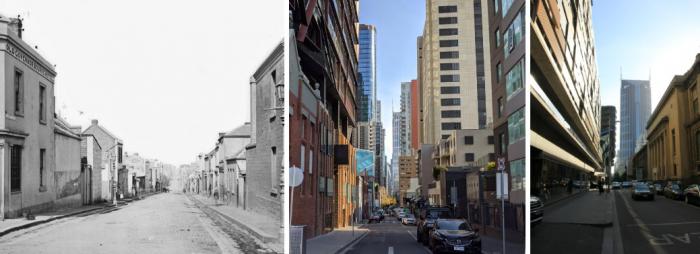
Little Lonsdale Street runs east/west between Lonsdale Street and Latrobe Strret in the centre of Melbourne, Victoria, Australia.
A part of the Hoddle Grid, Little Lonsdale Street runs from Spring Street at the eastern end to Spencer Street at the western end. It was named after William Lonsdale, the first administrator and magistrate in Melbourne.
Little Lonsdale Street car traffic runs one-way in an easterly direction, unlike all the other "little streets" not west.
Why does Little Lonsdale Street traffic run the other way?
We get asked "a lot".. why does it run the other way? Little Lonsdale Street's direction differs from other "little" streets in Melbourne because its one-way flow was reversed in 1961 from west to east as a traffic management idea in the central business district.
Another interesting feature about Little Lonsdale Street: The city's grid was planned using magnetic north, which has shifted over time, causing the grid to be slightly rotated from true north. I don't really understand this, but its quoted many times. I suspect the street is aligned slightly to the North.
Little Lon
From Wikipedia, the free encyclopedia
In the nineteenth century, the eastern end of the street ran through a notorious "red light district", known as "Little Lon", associated with prostitution, petty crime and "larrikinism".
The area was roughly bounded by Lonsdale, Spring, Stephen (later Exhibition) and La Trobe streets. Little Lonsdale Street itself ran through the block, and the area was further divided by numerous narrow laneways. In the nineteenth century the area consisted of timber and brick cottages, shops and small factories and was home to an ethnically diverse and generally poor population. Today there are few reminders of the area's former notoriety.
Prostitution, petty crime and larrikinism
Archaeologist Justin McCarthy suggests that by 1854, only twenty years after Melbourne was established as a city, the area was well established as a notorious "red light" and slum district. It was associated with prostitution, petty crime and larrikinism. The numerous narrow back alleys and small cottages of this area housed, by this time, a growing number of prostitutes, The Argus newspaper at the time complaining of "females of the lowest and most disreputable class, who pursued their calling with the lowest and most filthy language and conduct." Prostitution was linked with "larrikinism" in official reports, as in the following description of the corner of Little Lonsdale and Leichardt Street from 1882:
From 11 o'clock in the forenoon till 3 or 4 next morning - there is fully thirty larrikins from 14-22 years of age...[that] live entirely on their prostitutes... they watch during the night for men intoxicated to rob them...they know the time the police is due [so] they disperse until they pass.
In 1891, Melbourne city's back slums were described by evangelist Henry Varley as "a loathsome centre in which crime, gambling hells, opium dens and degraded Chinese abound, and where hundred of licentious and horribly debased men and women are herded like swine". These places were "a disgrace to any civilized city on earth." Fergus Hume's immensely popular The Mystery of a Hansom Cab, written in 1887, described life in a slum in the nearby lanes behind Little Bourke Street, as exposed by its middle class heroes. Writing in 1915, C. J. Dennis's humorous novel The Songs of a Sentimental Bloke spoke of the "low, degraded broots" (brutes) of Little Lon.
Little Lon's most opulent brothels tended to face main streets, but were discreetly run. "Disorderly" or "low class" brothels tended to be in the narrower laneways behind. Tobacconists, confectionery, cigar and fruit shops in the area also sometimes acted as fronts for prostitution. In the small houses of the laneways, single or small groups of prostitutes also ran the most primitive cottage brothels. For example, the still extant Number 17 Casselden Place was operated by a single Chinese prostitute known as "Yokohama" (Tiecome Ah Chung) as late as the 1920s.
"Madam Brussels", facing Lonsdale Street, attracted a wealthy class of clientele, and consequently also greater notoriety, although prostitution itself was not illegal in 19th century Victoria. In 1878 a Select Committee Report on the Prevention of Contagious Diseases included the following evidence about Madam Brussel's brothel at 32-34 Lonsdale Street, from Sergeant James Dalton:
Q. How many brothels does Mrs B. keep?
A. She has two splendid houses in [Lonsdale] Street that cost her GBP1,300, and those two houses are her own property... and then she has two cottages in - Street and she has ...in - Street too.
Madam Brussels was far from the only elite brothel in the area. In 1867 Police Commissioner Standish introduced the visiting Prince Alfred, Duke of Edinburgh, to a brothel run in Stephen Street by Sarah Fraser. Other "orderly" brothels also included those of "Scotch Maude" and Biddy O'Connor.
In October 1891, the mace of the Victorian parliament was stolen. It was claimed that it had found its way to Annie Wilson's "Boccaccio House", in the Little Lon district, where it was supposedly used in a mock parliament. It was not recovered. The connection between Victoria's politicians and the brothels of Little Lon was reinforced when Chief Secretary Sir Samuel Gillott was revealed to have had ongoing financial dealings with Madam Brussels.
Understanding the people of Little Lon
Recent writers have emphasized the vibrancy and complexity of Little Lon's population of migrants and itinerant workers, and challenged the stereotype of the area as a miserable slum. This also seems to have been born out by the major archaeological studies conducted in the area in 1988 and 2002, which discovered a wide variety of objects from abandoned cesspits and rubbish dumps. Many were typical of domestic use in the nineteenth century, but a number gave indications of a flourishing community and occasionally, prosperity. Dr. Alan Mayne has commented; "Little Lon was clearly not, as the slummer genre would have it, an unstable mishmash of listless and directionless deviants. Nor were its inhabitants passive victims to poverty." By the end of the nineteenth century, the area had become home to a diverse migrant population of Chinese, German Jews, Lebanese and Italians.
Changes in the early twentieth century
Leanne Robinson comments that in the early twentieth century the Little Lon district began to change significantly. Newspapers had increasingly demanded a cleanup of the area, John Norton's The Truth being particularly vocal in its attacks, especially on Madam Brussels, the "queen of harlotry." Workshops and small factories increasingly took over the area. Many of the hotels and brothels were gradually being demolished and "prostitutes found themselves forced into... areas such as Gore Street and the notorious 'Narrows' around the Fitzroy Town Hall" Policemen had greater powers and prostitutes were subject to new laws. Around 1914, the buildings between 6 and 34 Lonsdale street, including Madam Brussels former brothel (which had closed in 1907) were demolished and replaced by small factories.
However, people continued to live in the area until the 1950s, when much of the district was compulsorily acquired for redevelopment by the Federal Government. In the early 1990s, a former resident of the Little Lon district was interviewed. Marie Hayes lived in her parents' home in Cumberland Place (in the northern half of the district) until she married in 1940. She reported that later in life, her mother Bridget said of Little Lon
This area used to have a bad name. Some of these streets were not pleasant, but everyone has always been kind to us. No one has ever molested us, or even made us afraid. When you have lived so long in the heart of the city, you want to stay here always.
The area today
In the northern half of the district, all buildings and streets were demolished in the late 1950s to make way for Commonwealth buildings. Today, only a few nineteenth century buildings survive in the southern half of the area. These include
17 Casselden Place, (see below) a former house built in 1877. Typical of cottages built in the mid nineteenth century and originally one of a terrace of six. This is the only nineteenth century single story dwelling in the area to survive.
Oddfellows Hotel, built c.1853 at 35-9 Little Lonsdale Street. Although now a licensed premises, this building has had a number of uses, including a Chinese furniture maker's factory.
Black Eagle Hotel built c.1850 at 42-4 Lonsdale Street, now a shop.
Factory at 25 Little Lonsdale Street. A former shop and forge, built about 1868 for engineer Alexander Lugton. This is one of few surviving examples of the small businesses that operated in the area in the nineteenth century. The company expanded in the late nineteenth century and eventually took over a number of buildings in the district.
Elms Family Hotel, on the corner of Spring Street and Little Lonsdale Street. This is the only commercial business in the area that has operated continuously on the same spot in the district since the mid nineteenth century, although the building has been remodeled. The hotel ceased operation in 2016.
Church of England Mission building, next to the Elms Family Hotel, one of a number built in the district by Church missions to cater for local residents.
118-162 Little Lonsdale Street, 100 metres west of the area. A small streetscape of former shops and dwellings between Exploration lane and Bennetts Lane, that most resembles the Little Lon of the nineteenth century.
Several other buildings in the district have been redeveloped or incorporated into modern office blocks.
These include
"P.N.Hong Nam" Building at 268 Exhibition Street. This was built as a factory and shop c.1910.
"Khyat and Co" Building at 76 Lonsdale Street. Built as a factory in 1922.
"Coopers Hotel" at 282 Exhibition Street. Originally built as a hotel for James Cooper in the 1850s, but later delicensed. The building served as a Mission building, a home for girls, and later a post office before being reopened as a hotel.
Major archeological digs were conducted in the area in 1988 and 2002. Many of the objects uncovered are on display at Museum Victoria in a recreated "Little Lon" streetscape.
1987-1988 Excavation
In the summer of 1987-88, almost an entire block at the northern end of Melbourne's Central Business District was excavated by a team of historical archaeologists, before being redeveloped for tall office buildings. About 17,000 items were collected and described, and they are now held within Museum Victoria's Department of Social History.
Some of the objects found by the archaeologists are described and interpreted. There are images of the streetscape and how it has changed, information about some of the people who lived in the area, and descriptions of activities and events which occurred there. museumsvictoria.com.au
Casselden Place
Casselden Place leads south from Little Lonsdale Street towards Lonsdale Street, between Exhibition and Spring streets. In 1850, the lane primarily contained domestic and commercial buildings. This remained the case up until 1920, when the only non-residential building was a bellows manufacturer. Because of the unsanitary conditions in Melbourne laneways, laneway residences generally housed the lower classes. The conditions in Casselden place were described in a report by the Assistant Inspector of Nuisances, Edward Thunderbolt, in 1891.
I visited the premises occupied by K Rahirnbux at 8 Casseldean Street where I found two overflowing Privy Pans in a most filthy state yesterday 9th inst. I have cautioned the same man on the 3rd inst about the same class of nuisance then, when I informed Mr K Rahirnbux how to abate the nuisance and that he may be summoned if he did not abate the same on the 3rd inst I counted 33 men on the same premises and yesterday 29 men on the same premises all Indians.
In 1911, the lane was known to supply sly grog (that is, to sell alcohol with no licence). Casselden Place was cleared for construction of the Commonwealth Offices in 1988, but before the new skyscraper was erected, archaeologists and volunteers unearthed a great variety of domestic and industrial artifacts in the laneway. Some of the brick cottages of the 1870s still stand in Casselden Place, with historical installations describing their previous occupants. Casselden Place now connects to Lonsdale Street via the restaurant and café-lined pedestrian walkway known as Madame Brussels Lane.
The house at 17 Casselden Place is a single-storey brick cottage of three rooms, the last remaining of a row of six cottages built in 1877 on the west side of Casselden Place, a laneway running off Little Lonsdale Street in the once-notorious Little Lon area of Melbourne. The land around Casseldon Place had been subdivided and sold in 1847 and five two-room wooden cottages were built there, most probably just before the Melbourne Building Act came into effect in January 1850. This was introduced to restrict the spread of fire and specified the use of fireproof building materials. These cottages were bought in 1871 by John Casselden, but there are no records of any earlier building having been constructed at 17 Casselden Place. In 1877 Casselden, who had been first recorded in 1853 as a shoemaker and later as a newsagent, had six new brick cottages built by George Tuxworth. The six cottages were always rented out, often to Chinese men or single women, who were attracted by the cheap rental and central location. The single women were likely to have been among the many sex workers who worked in the area and were stigmatised by those who thought them less respectable. The cottages remained in Casselden's possession until 1890, after which they changed hands every few years until the Commonwealth Government took possession of the area in 1948. In the 1960s the other five of the six cottages were demolished leaving number 17 as the sole survivor, which in 2010 is used as an office. The city block on which the house is located has been redeveloped, and the house is now almost surrounded by high-rise buildings: the Telstra national headquarters, the Casselden Place office tower and The Urban Workshop.
The house at 17 Casselden Place is a small three-room cottage constructed of machine-made bricks on bluestone footings and has a gabled slate roof. There are two main rooms, one, which opens directly off Casselden Place, has a fireplace with a timber surround (likely to have been installed some time after the building was constructed), a timber dado and a wooden ceiling. The other room, originally a bedroom with no fireplace, opens off this. The small kitchen is in a rear skillion and opens off a small bluestone-paved courtyard, which also contains a brick WC structure, which retains with some early water piping and evidence of its former nightsoil function.
The house at 17 Casselden Place is of architectural and historical significance to the state of Victoria.
The house at 17 Casselden Place is historically significant as the only surviving example in the city of the many single-storey workers' houses that were built along the back lanes of the central city as rental investments from the early 1860s. It is a demonstration of the way of life of the city's poorer residents in the second half of the nineteenth century. The good quality of its materials and construction are probably a reflection of the Melbourne Building Act which came into effect in 1850. The small scale of the cottages reflects the circumstances in which many inner-urban poor found themselves, unable to find or afford more substantial lodgings. The artefacts uncovered by the large-scale archaeological excavation of 2002-04 revealed the frugal respectability of Melbourne's working class poor, who expressed pride in their homes through the possessions they acquired and used to decorate their homes.
The house at 17 Casselden Place is architecturally significant as the last of the many single-storey workers' cottage built in the city of Melbourne during the second half of the nineteenth century to survive intact. It is a unique example of a small-scale workers cottage of the second half of the nineteenth century, and is notable for the quality of the materials and the workmanship.
A second archaeological dig was undertaken at Little Lonsdale Street in 2002.
❊ Address ❊
℅ Naarm
⊜ Little Lonsdale Street Melbourne 3001 View Map
❊ Web Links ❊
➼ en.wikipedia.org➼ wikipedia.org/Little_Lonsdale_Street
➼ wikipedia.org/Little_Lon_district
Trending HOT

Australia's first regular-season NFL game has made the MCG one of Melbourne's hottest tickets, with tickets sold out. If you missed a seat for the Los Angeles Rams v..

Make the most of your weekend in Melbourne with these fabulous events. No city does it better than Melbourne, so get out and discover the very best shows, festivals,..
Update Page
Tags: Little,Lonsdale,Street,expo,history,museum,auto,kids