Melbourne Laneways |
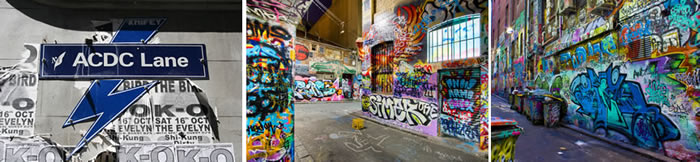
Melbourne Laneways are known worldwide for a rich art culture, one-off boutiques, unique galleries, tiny cafes and hidden bars.
No trip to Melbourne is complete without a visit to Melbourne's laneways.
Victoria's tourism slogan aims to make Melbourne the destination of choice for Australia's elite by urging visitors to Lose Yourself in Melbourne.
This is an information page about Melbourne's Laneways, where they are and how to get to them.
Melbourne Lanes
Lanes that have ** next to their name have more information below.
--> ACDC Lane (AC/DC Lane)**
--> Amphlett Lane off Little Bourke Street between Spring and Exhibition streets | 18/2/2015
--> Beaney Lane
--> Bennetts Lane
--> Bligh Place
--> Celestial Lane
--> Club Lane
--> Cohen Place
--> Commerce Way
--> Crombie Lane
--> Dame Edna Place**
--> Davisons Place
--> Duckboard Place
--> Evans Lane
--> Exploration Lane
--> Flinders Court
--> GPO Lane
--> Gun Alley
--> Hardware Lane**
--> Hayward Lane
--> Heffernan Lane
--> Highlander Lane
--> Hosier Lane**
--> Howey Place
--> Juliet Alley
--> Jones Lane
--> Literature Lane**
--> Manchester Lane
--> Manton Lane
--> McKillop Street** (odd name for a lane)
--> Meyers Place
--> Niagara Lane**
--> Rankins Lane
--> Racing Club Lane
--> Romeo Alley
--> Scott Alley**
--> Temperance Hall Lane
--> The Causeway
--> Waratah Place
--> Warburton Alley
--> Windsor Place
By Lane
ACDC Lane (AC/DC Lane)
Formerly Corporation Lane, and one of Melbourne's best known laneways.
ACDC Lane was renamed in memory of one of Australia's best known bands and the city where AC/DC started their career, Melbourne.
The main street sign (ACDC Lane) has been stolen a number of times. Although the laneway has no real connection to AC/DC, Angus Young (Lead Guitarist) has visited. Hard Rock Cafe where AC/DC began playing was (no longer) situatioed not far from this lane on the corner of Spring and Flinders Street.
ACDC Lane connects with Duckboard Place, between Flinders Lane, Flinders St, Russell St and Exhibition St. Map
View AC/DC Lane Picture Gallery
Amphlett Lane
Amphlett Lane sits off Little Bourke St, near Spring St, close to the Palace Theatre.
Dame Edna Place
Dame Edna Place located off Little Collins St, between Swanston and Elizabeth streets, was crowded with interested lunchtime "possums"for the launch on the 8th March 2007. It can truly be said this is a star studded laneway well worth a visit... and don't forget.. look down! Formerly Browns Alley Map
Hardware Lane
The heart of Melbourne's laneway renaissance. Hardware Lane, epitomises the enchanting atmosphere of such environments. The architecture of Hardware Lane and nearby Goldie Place is also something of a quaint historical portrait, with early 1900s warehouses originally home to blacksmiths, horses and the like, still intact.
Today, however, they operate as restaurants. The original fa'ades remain, enhancing the authentic nature of this precinct while complementing its modern regeneration as an area of leisure. Map
Hosier Lane
For a true understanding of laneway art, a journey of exploration into side lanes must be taken, as it is here that street art and an authentic urban voice can be found.
Graffiti though it may be. these colourful references to popular culture and youth subcultures dominate the concrete walls of tiny Hosier Lane, Rutledge Lane, Caledonian Croft Alley, Duckboard Place and ACDC Lane. Map
Literature Lane
Literature Lane is a previously unnamed Melbourne laneway near the State Library. Launched 21 May 2012 will be a lasting legacy of the National Year of Reading as well as a celebration of Melbourne's UNESCO City of Literature status.
It is a U-shaped lane off Little La Trobe St. There is a wealth of graffiti, art and new architecture (and see that patterned screen giant mural on the office block!) blending with the old around this lane. Source | Map
McKillop Street
McKillop Street is a laneway running between Bourke and Little Collins Street with small boutique shops and outdoor dining cafes. Map
Niagara Lane
Niagara Lane is between Little Bourke St and Lonsdale St. Map
Scott Alley
Seek out side streets Scott Alley for original pieces, and savour them, as their designers may soon be household names and their early work priceless. Map
Malbourne Laneway Info
Visitors can visit Melbourne's laneways as they are open 24/7, and free.
Tours
Take one of the excellent guided walking tours which take in all the best known laneways and explain the history and often missed aspects of each lane way.
--> View Melbourne Laneway Tours
Online Laneway Guides
City of Melbourne has an excellent guide to Melbourne laneways.
--> whatson.melbourne.vic.gov.au
visitvictoria.com guide to Melbourne's hive of bustling, creative laneways.
--> View visitvictoria.com
Free Laneway Map
Explore Melbourne's lanes, alleyways, little streets, arcades, cafe society and fascinating shops. Walking time 1.5 hours. Distance 2.5 km.
--> MAP (PDF) * Courtesy of whatson.melbourne.vic.gov.au
APP
This handy app offers city maps and self-guided walking tours for over 470 cities worldwide. Detailed walking route maps and turn-by-turn walking directions are available to guide you to all major city attractions.
You can also read an excellent walk through guide to Melbourne Laneways at www.gpsmycity.com
What's in a street name?
The Age By Andrew Webster February 19, 2004
... But Melbourne's lanes and alleys offer a more down-to-earth record of the city's evolution. "The lanes really grew their own names,"Professor Bate, president of the Royal Historical Society of Victoria, said.
With some 115 entries, the society yesterday launched its first handy reference guide to the names of Melbourne's streets and lanes. Aimed at visitors and Melburnians, the pocket brochure explains the origin of most of the city's streets, lanes and alleys.
Aimed at visitors and Melburnians, the pocket brochure explains the origin of most of the city's streets, lanes and alleys. According to Professor Bate, the early lanes sprang up as Melbourne's settlers subdivided the big blocks between Sir Richard's grand streets into more manageable units.
Many lanes were filled with workers' cottages. "People often named them after pubs and hotels on corners,"Professor Bate said. No fewer than 21 entries can be traced back to gold-rush Melbourne's affection for alcohol.
Professor Bate's favourite, the cobbled Niagara Lane, lies nestled between well-preserved, red-brick warehouses off Lonsdale Street where the Niagara Hotel plied its trade.
Later, as Marvellous Melbourne boomed, lane names recorded the city's burgeoning specialist trade areas and long-vanished businesses - Hosier Lane off Flinders; Kirks Lane, once home to Kirk's Horse Bazaar between Swanston and Queen Street; biscuit baker TB Guest and Co in William Street is remembered by the eponymous lane between Lonsdale and Little Bourke.
However, some memories have all but been erased. Romeo Lane and Juliet Terrace near the Princess Theatre were once infamous dens of love of a commercial, rather than star-crossed nature. According to Professor Bate, Melbourne councillors reacted by attempting a futile rebranding exercise.
"The good city council decided they would have to change the names and so they became Liverpool and Crossley Streets,"he said. "But of course the brothels remained."
Melbourne's Streets and Lanes is available free from the society's offices in A'Beckett Street (named after Victoria's first chief justice Sir William A'Beckett) and at the visitor centre at Federation Square.
Also see Melbourne Street Name Origins
❊ Also See.. ❊
➼ Amphlett Lane
➼ Hosier Lane
➼ Melbourne Street Art Locations
❊ Trending HOT ❊

Make the most of your weekend in Melbourne with these fabulous events. No city does it better than Melbourne, so get out and discover the very best shows, festivals,..

and then there were 2 teams left in the race for AFL Premiers 2026. 2026 Toyota AFL Grand Final Saturday 26th September 2026 Fremantle -v- Brisbane Lions The..
Update Page
Tags: culture,history,nature,auto,expo,museum,travel