Royal Exhibition Building |
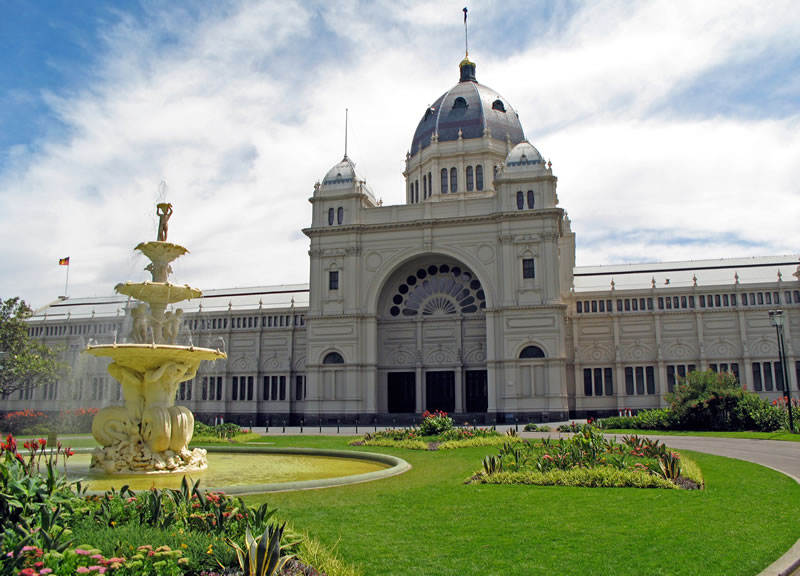
The magnificent Royal Exhibition Building was completed in 1880 in time to host Melbourne's first International Exhibition.
The first exhibition was a huge success, over 8 months attracting over one million people to the eight hectares of exhibitions. The cultural, industrial and technological achievements of more than 30 nations were proudly displayed to a public thirsting for information and new ideas. A second exhibition took place in 1888 when the Melbourne Centennial Exhibition was held to promote the centenary of European settlement in Australia [1788].
Since then the building has hosted a wide variety of local, national and international events but the most important of these was the opening of the first Commonwealth Parliament of Australia on 9 May 1901, by the Duke of Cornwall and York, the heir to the throne.
More than 10 000 guests were present, including politicians, naval and military officers, judges, consuls, mayors and clergy. The building was again the location for a special sitting of Parliament during the 2001 Centenary of Federation celebrations.
Today, the Royal Exhibition Building flourishes as one of the world's oldest and largest exhibition pavilions, symbolising the great 19th century international exhibition movement. On 1 July 2004, it became the first building in Australia to win World Heritage listing.
With its meticulously restored opulent interior, expansive galleries and soaring dome, the Great Hall offers a magnificent setting for trade shows, fairs and cultural and community events. The north facade of the building is visible again for the first time in many years, following the demolition of the 20th century annexes.
Today it hosts exhibitions, fairs and shows throughout the year along with hosting launches, exams and private events.
The Royal Exhibition Building is located just north of Melbourne's CBD, next to the Melbourne Museum in Carlton Gardens.
What's On
Transport Options
Public Transport Options
Plan your trip using Metlink's Journey Planner.
Transport options include:
 Tram 86 or 96 to corner of Nicholson and Gertrude Streets Free City Circle Tram to Victoria Parade City loop train to Parliament Station Bus routes 250, 251 and 402 to Rathdowne Street Stop #5 of the Melbourne Visitor Shuttle
Cyclists
Local bicycle facilities include bike lanes on Rathdowne St and Canning St. There is also a shared pedestrian/bike path on Nicholson St. Bicycle racks on the Plaza provide ample bike parking just outside the front door.
Car Park
The Melbourne Museum undercover car park is open from 6.00am to midnight daily. Enter via Rathdowne Street or Nicholson Street.
❊ What's On ❊
➼ Bowens Building & Innovation Expo (Trade Only)
➼ Melbourne Aquarium 1930 - 1953
➼ Royal Exhibition Building Dome Promenade Tour
➼ Melbourne Italian Festa & Expo 2026
➼ The Little Food Market 2026
❊ Address ❊
℅ Wurundjeri Country
⊜ 9 Nicholson Street Carlton 3053 View Map
✆ Telephone: 13 11 02 | +61 3 9270 5000
❊ Web Links ❊
➼ museumsvictoria.com.au➼ www.museumsvictoria.com.au
❊ Also See.. ❊
➼ Carlton Gardens
➼ Melbourne Museum
➼ Museums Victoria
Trending HOT

Make the most of your weekend in Melbourne with these fabulous events. No city does it better than Melbourne, so get out and discover the very best shows, festivals,..
Update Page
Tags: air,garden,museum,sport,auto,culture,expo,history,nature,science,travel